

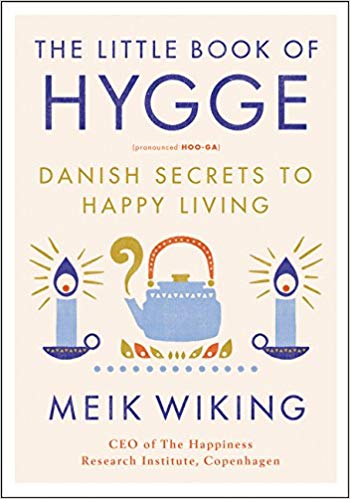

It was in 2016 that I began seeing articles about the Danish/Norwegian concept of hygge (pronounced hoo-gah). I quick search on Amazon now returns more than 2,000 results for books tagged with the keyword. Wikipedia defines hygge as “a mood of coziness and comfortable conviviality with feelings of wellness and contentment.”
The Meik Wiking book pictured above has sat on my shelf, collecting dust, since I compulsively purchased in in the winter of 2016. In search of a different book altogether (which I still can’t find!), I resurfaced this book on hygge and dived in. I read from the middle of the book to the end, and then started at the beginning again, unable to put it down.
Why do I love this so much? First, I have to explain the basics of hygge. In Weiking’s book, he offers the Hygge Manifesto (enumerated in the book, comments in parentheses are mine except those in quotes):
- atmosphere (creating a physical environment of peace and comfort)
- presence (being here now, in mind and body)
- pleasure (physical pleasures like environment, clothing, food, and drink)
- equality (shared social time, “we over me”)
- gratitude (presence in and thankfulness for the moment)
- harmony (social calm, absence of competition)
- comfort (again focusing on physical comfort)
- truce (tabling of contentious topics, creation of a safe space)
- togetherness (“building relationships and narratives,” memory-building)
- shelter (protection from the outside world)
You can see that many of these overlap, but there’s a lot of nuance as well. There is so much about this that appeals to me: the focus on creating a safe and comfortable physical space, the emphasis on shared experiences, the importance of food and drink, the attention to the moment and to gratitude.
Weiking highlights some of these ideas when he lists foods that are hygge: things that take a long time to cook (like braises), anything you cook with friends or family, and foods that are rustic and simple. Foie gras, he says is not so hygge; but popcorn is– “especially if we share the same bowl.”
A couple of other points illuminated in the book also really resonate. First, the importance of the past and the future in sharing experiences. A significant part of experiencing hygge is also in planning for it, talking about it, and then remembering it. If you’re planning to have friends over for dinner on Friday, you plan it together and then discuss how hygge it will be. Anticipation is key and that anticipation is shared. Past events are also relished in conversation together: remember that time last year when we went hiking and got caught in a downpour? Remember that Renee brought that thermos of hot chocolate, and we all shared it under the shelter of that big tree until the rain stopped? It’s like anticipatory gratitude, gratitude in the moment, and rearview mirror gratitude– all linked like beads on a string and all shared.
The key to this, I think, is that there is a shared concept AND a widely-accepted word for it. When I consider the closest approximation in English, coziness, it sounds so frumpy and lame. Definitely not a word that I would use when planning a dinner party: I’m so excited you are coming to dinner on Sunday. It will be so cozy! I don’t think so.
The second point that really resonates for me is the idea of anti-hygge. The only way this thing can exist, the author explains, is in opposition to something else. The Friday night get-together, cooking with friends, is the antithesis of the busy workweek. The comfort of a warm, quiet house is enhanced by the thunderstorm raging outside. The weekend at a rustic campsite is reciprocally enhanced by the hot shower you know awaits on Sunday night.
Now I’m looking for every opportunity to find and create the hygge in my life. As I tuck into a pile of books from the library (most with the h-word in the title), I feel thankful that I can consciously cultivate this idea– and share it with you.




 Go Forth